The Saint Louis University Division of Nephrology offers comprehensive care for patients with acute and chronic disorders of the kidney and urinary tract.
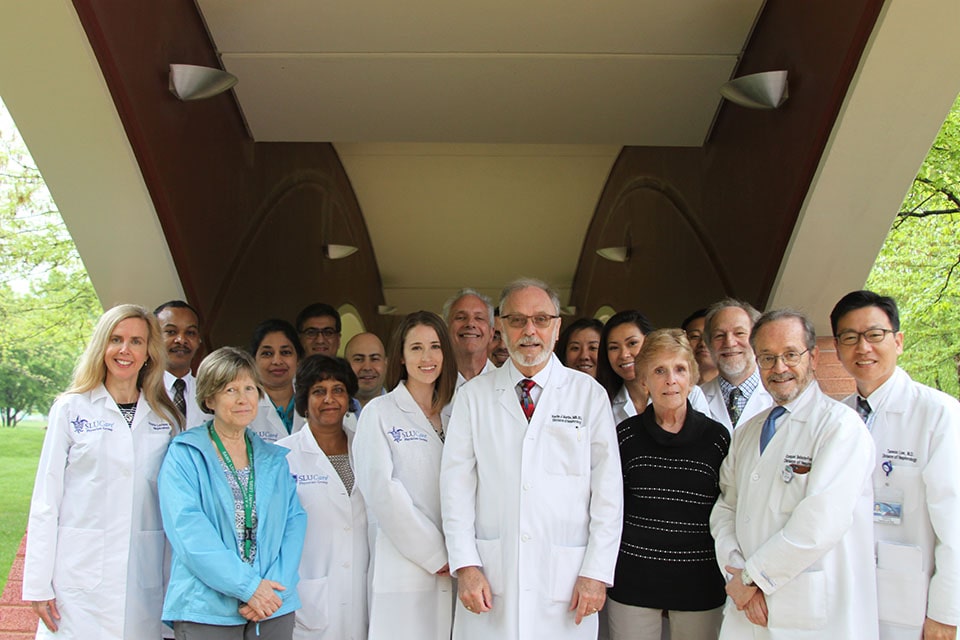
Our clinical services include inpatient and outpatient hemodialysis, critical care nephrology, continuous renal replacement therapies, peritoneal dialysis, renal transplantation, renal biopsy and imaging, interventional nephrology and advanced hypertension care. Since our inception, our goal has been focused on building a world class comprehensive training program.
Our program has been continuously accredited by the Accreditation Council for Graduate Medical Education (ACGME) for more than 25 years and we have graduated nearly 100 fellows.
Many of our fellows have gone on to successful careers, either in academic medicine or as clinical nephrologists. We offer robust inpatient and outpatient rotations, focused on all forms of renal replacement therapy (hemodialysis, continuous renal replacement therapies, peritoneal dialysis and home therapies), renal transplantation, interventional nephrology, advanced hypertension diagnosis and management, and a wide range of general nephrology problems (glomerular disease, fluid and electrolyte disorders, acute and chronic kidney disease).
Faculty
- John Edwards, M.D., Ph.D.
Professor and Director, Division of Nephrology
Associate Chair for Research, Department of Internal Medicine - Kevin J. Martin, M.B., B.Ch., F.A.S.N.
Professor of Internal Medicine - Bahar Bastani, M.D.
Professor
Transplant Nephrology - Krista Lentine, M.D., Ph.D.
Professor
General and Transplant Nephrology - Geetha Maddukuri, M.D.
Associate Professor
VA Staff Physician - Marie Philipneri, M.D, Ph.D.
Professor
Hypertension and Dialysis - Thanh-Mai Vo, M.D.
Associate Professor and Program Director
General and Interventional Nephrology - Mowaffaq Said, M.D.
Associate Professor
General Nephrology and Dialysis - Ezequiel Bellorin-Font, M.D.
Instructor
General Nephrology - Taewoo Lee, M.D., Ph.D.
Instructor
General Nephrology - Stephanie Shieh, M.D.
Associate Professor
VA Staff Physician - Kana Miyata, M.D.
Assistant Professor
General Nephrology - Fadee Abu Al Rub, M.D.
Assistant Professor
Transplant Nephrology - Yasar Caliskan, M.D.
Instructor
Transplant Nephrology - Posan Limbu, M.D.
Assistant Professor
General Nephrology
- Ariel Schnell, PA-C
Physician Assistant
General Nephrology and Dialysis - Amy Mosman, PA-C
Physician Assistant
Hypertension and Dialysis